


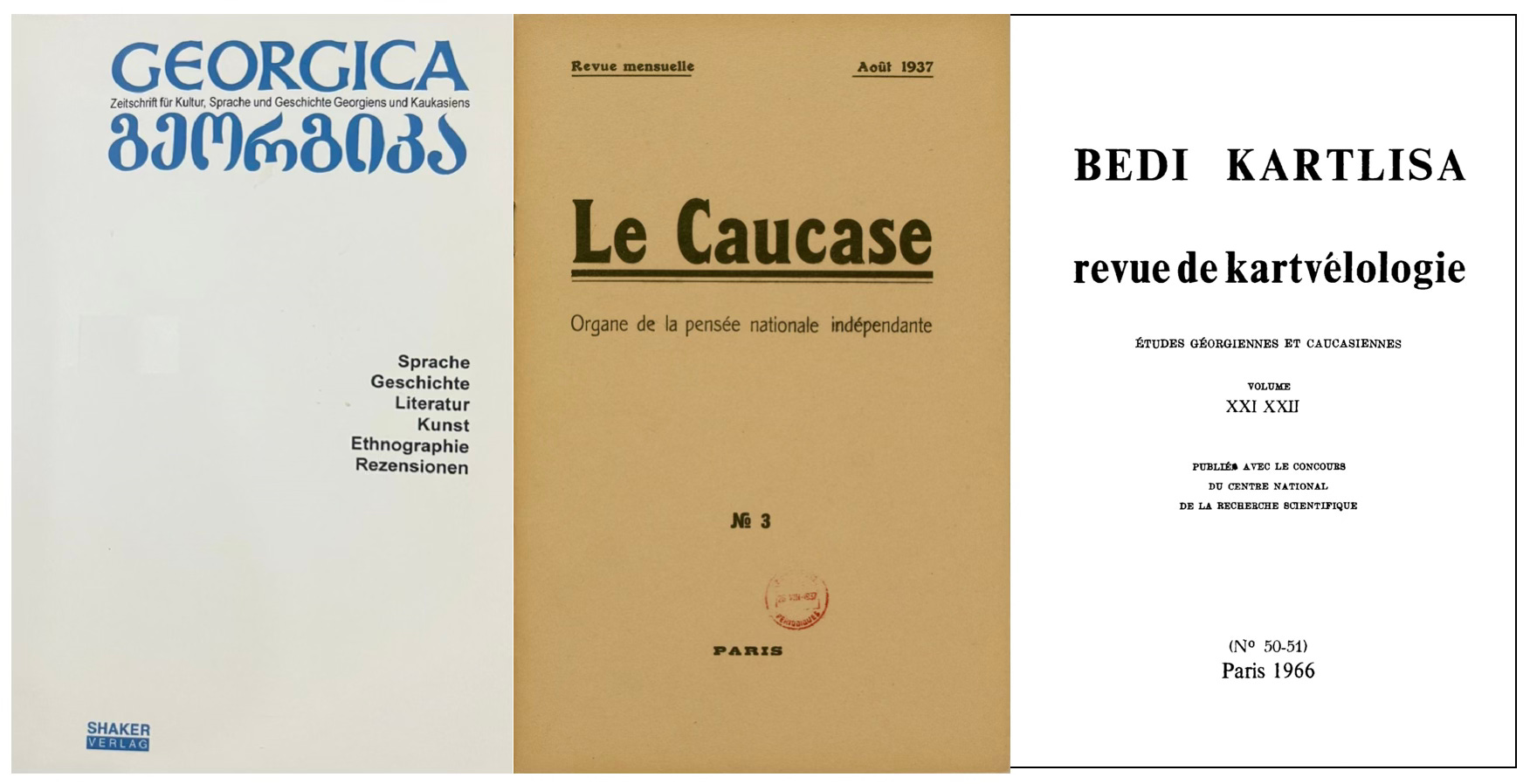
Kartvelian studies emerged long before it acquired a name. The earliest attempts to describe Georgia and its inhabitants appear in classical Greek and Roman texts (e.g., Hippocrates, Aristotle, Strabo, Pliny the Elder, Plutarch), where the region entered written history as a geographic, ethnographic, and political curiosity.
Over the following centuries, scattered references gave way to more sustained observation, particularly through Byzantine sources and early modern travel writing of the 17th and 18th centuries. This long, uneven process came to a head in the 19th and early 20th centuries, when Georgian culture began to be studied as a whole, spanning language, literature, art, archaeology, folklore, ethnography, history, law, and other humanistic disciplines. The establishment of Tbilisi State University (1918) and the Georgian Academy of Sciences (1941) was really what allowed the field to flourish.
In an article from The Karvelologist titled, “The problem: why is Georgian history so little known in the West?”, the author suggests several reasons for a lack of outside scholarship [1]:
A major problem is location: Georgia lies beyond Constantinople, beyond our artificial boundary of “Europe”; yet we do not associate Georgia with the Near East. Language has not helped; both the Georgian script and grammar are immensely challenging. In addition, a constantly changing mosaic of political entities hampers acquaintanceship. Religion has not helped; only the specialist sees beyond Western European Catholicism and Protestantism. Georgia (at least until 1990) could be termed “a stepchild of history”, presented to us most often as a footnote to Persian, Turkish, and Russian history, shamefully shortsighted and intellectually limited though this is.
Taken together, these explanations point less to an absence of material than to a deeper problem of how Georgia has been positioned within Western historical narratives. In essence, it doesn’t fit neatly into the categories that scholarship relies on. As a field formed to study a society that consistently resists such categories, kartvelology comes about in response to this structural blind spot.
Kartvelian studies, then, is an attempt to treat Georgia as a subject rather than an afterthought. The journals1, institutes, and cross-disciplinary work that define the field grew out of a practical need: to bring together a history and culture that had long been scattered across other traditions or ignored altogether. The aim in this article is not to survey Kartvelology, but to explain why such a field had to be created in the first place, and what that need says about the gaps in how history is usually written. The article quoted earlier closes with a proposition:
In the age of the internet, can we not ask for a site and service to make English-language materials available to any interested reader? This is the vital first step in winning the wider audience that culturally rich Georgia so well deserves.
My answer to that is “yes”. And while only a small part of a much larger effort, the hope is that Georgiaphile can serve as one such bridge, or at least help extend it a little further.
Sources
1 - The problem: why is Georgian history so little known in the West?
ex. Bedi Karthlisa, Georgica, Le Caucase, The Kartvelologist, Kartvelian Heritage, et al.