


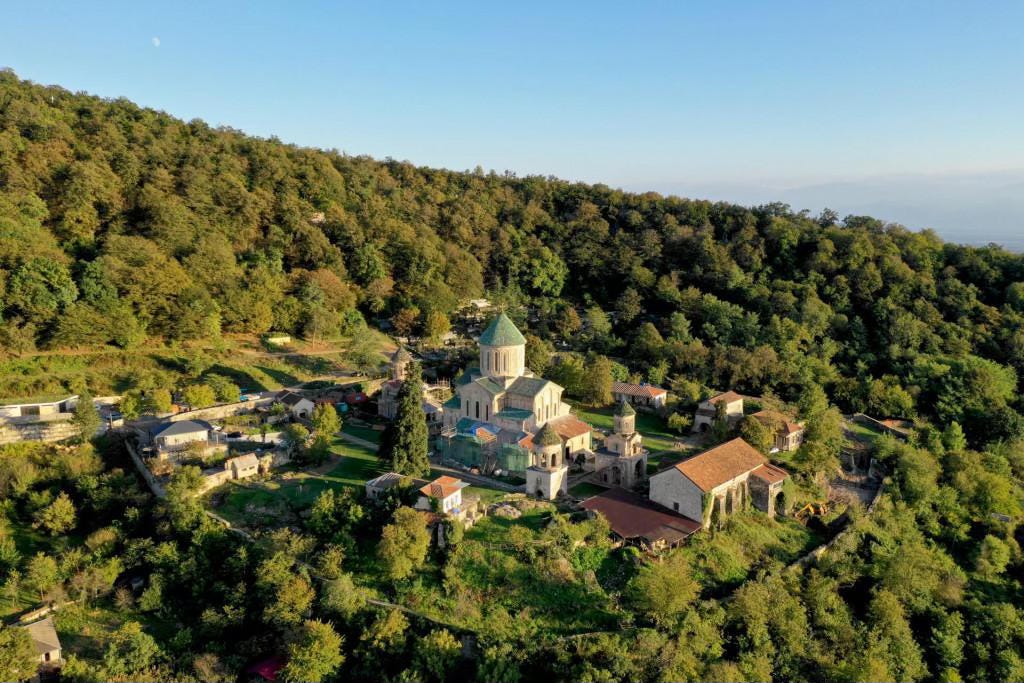
“This is now a foreshadowing of the second Jerusalem in the whole East, a school of all virtue, an academy of instruction, another Athens but much superior to it in divine doctrines,” wrote the royal chronicler of King David.
The “Golden Age” of Georgian culture, which occurred during the reign of King David the Builder and his great-granddaughter Queen Tamar, offered not only stability and growth for the newly unified country, but it resulted in great works of art, architecture, and literature [1].
At a time when traditional intellectual centers of Eastern Christianity, especially in Syria, were in decline, Georgia moved in the opposite direction. In between driving out the Seljuks (part of the Turko-Persian empire) and sending his children to study languages and literature abroad, he founded academies such as Gelati1 as a center for science and education [2]. These institutions were designed not only to teach but to conduct research, consciously modeling themselves on the great Byzantine academies of Constantinople. In this way, David the Builder sought to position Georgia as both an intellectual heir to Byzantium and a unifying force within Eastern Christianity [3].
According to Archpriest Ioseb Gogoladze, the name “Gelati” derives from the Greek genē (“birth”), which entered Georgian as genetos and later evolved into gaenati, a term linked to the Nativity of the Mother of God and reflected in the title Kutatel-Gaenateli [4].
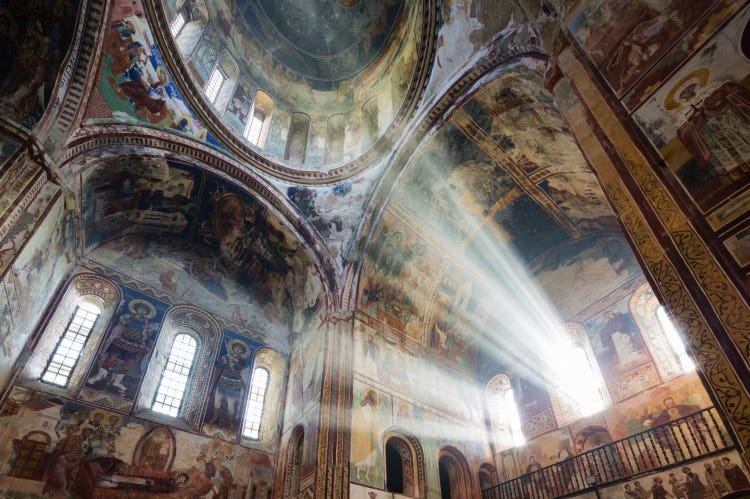
Gelati wasn’t just a hub of intellectual pursuits, it was a religious complex and architectural ensemble, as well as one of Georgia’s first monasteries. The main highlight of the complex is the Church of the Mother of God, which has survived in its original form. The dome painting of the church dates to the 12th century. The church preserves paintings from various periods as well as a 12th-century mosaic, making Gelati a sort of museum of Georgian monumental art.
Nestled in the hills of Kutaisi, overlooking the Tskaltsitela Valley, it also served as the de-factor center of western Georgia during King David’s reign. From there, he brought in many Georgian scientists, theologians, philosophers2 and scribes who translated classics and compiled manuscript copies3. That said, what Gelati produced wasn’t so much a body of identifiable works of original thought as it was a transmission and cultivation of knowledge.
Modern legacy

While King David was saddened at not witnessing the end of construction, the Gelati monastery was so important to him that he was buried there, along with nearly all Georgian kings after him. His dedication was such that the feast day of David the Builder was designated as the opening day of Tbilisi State University, emphasizing that TSU is the heir to Georgia’s old educational and cultural traditions, and specifically to the Gelati Academy [4].
Although medieval academies like Gelati (and its contemporary, Academy of Ikalto) disappeared long before the modern era, their legacy was never fully abandoned. When the Georgian Academy of Sciences was founded in 1941, it also explicitly named these institutions as its intellectual predecessors, framing modern Georgian scholarship as a continuation rather than a rupture [5]. In this sense, Gelati survived less as a building or curriculum than as an idea and teaches us that Georgia can be intellectually self-sustaining and culturally sovereign.
Sources
1 - History of Gelati
2 - 1700 Years of the Grapevine Cross: Christianity in Georgia
3 - The idea of the Gelati Monastery and Academy
4 - გელათის სამონასტრო კომპლექსი
5 - The Georgian Academy of Sciences
not to be confused with Accademia dei Gelati (Bologna, 1588)
such as Ioane Petritsi, Arsen Ikaltoeli, Arsen Bulmaisimdze, Petre Gelateli, Evdemon Chkhetidze, Ekvtime Sakhvarelidze, Gideon Lortkipanidze, Anton I, and Zakaria Gabashvili
held in the Kutaisi State History Museum