


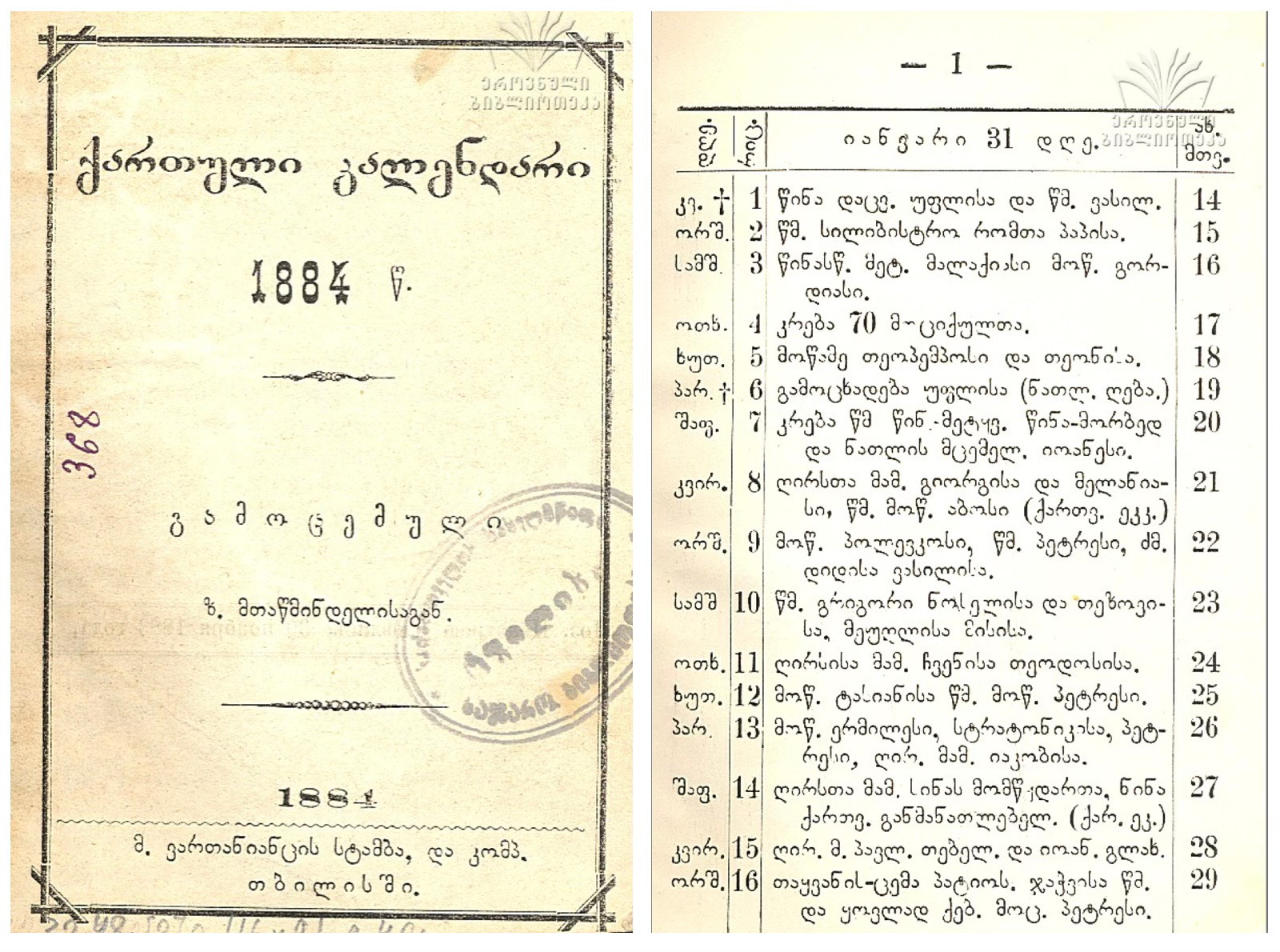
Georgia, like the rest of the Russian Empire, used the Julian calendar until 1918. After the October Revolution, the new Soviet government decreed a switch to the Gregorian calendar1 in January 1918. Amid the collapse of the imperial administration and broader regional reforms, Georgia adopted the Gregorian calendar the same year for practical reasons, aligning itself with Europe.
As Georgia declared its independence, the issue of the calendar was also raised in legislative and religious bodies. Kirion, the Catholicos-Patriarch of Georgia, received the following telegram [2]:
On April 13, a law was adopted in the Transcaucasian republics on the introduction of the new system of time reckoning; April 18 is to be recognized as May 1. Easter will be celebrated on May 5 (April 22, Old Style). Accordingly, movable feasts will be shifted forward by 13 days.
As a result of the government switch, dates shifted forward and people experienced “lost days”. What the telegram shows is that this effect was compounded by the fact that the Georgian Orthodox Church (GOC) started using a variation of the Julian calendar, keeping it 13 days behind the Gregorian for many fixed dates, leading to different holiday celebrations (like Christmas on Jan 7th) until the year 2100 when the gap increases.
By 1918, Georgians were already accustomed to calendar change. Older, agriculturally rooted month names - such as Tibatve and Mk’atatve (literally Months of Mowing and Reaping) - had gradually given way in official and urban use to international month names during the 19th century (such as Dek’emberi for December). The switch to the Gregorian calendar just added another layer to an already evolving system of timekeeping.
The result was parallel systems of time, not a single calendar, and they coexist in Georgia to this day. The Greeks famously distinguished time in two ways: chronos and kairos. The former is measured and sequential, while the latter is qualitative, sacred, and meaningful. The changes of 1918 disrupted both, yet they also reveal how Georgia has long balanced practical needs with spiritual and cultural continuity.
Sources
1 - ქართული კალენდარი 1884
2 - ახალი სტილის საკითხი ქართულ მართლამადიდებლურ ეკლესიაში
Introduced by the Pope in 1582, the Gregorian calendar corrected a gradual drift in the Julian system that had displaced the date of Easter and other feasts over time.