


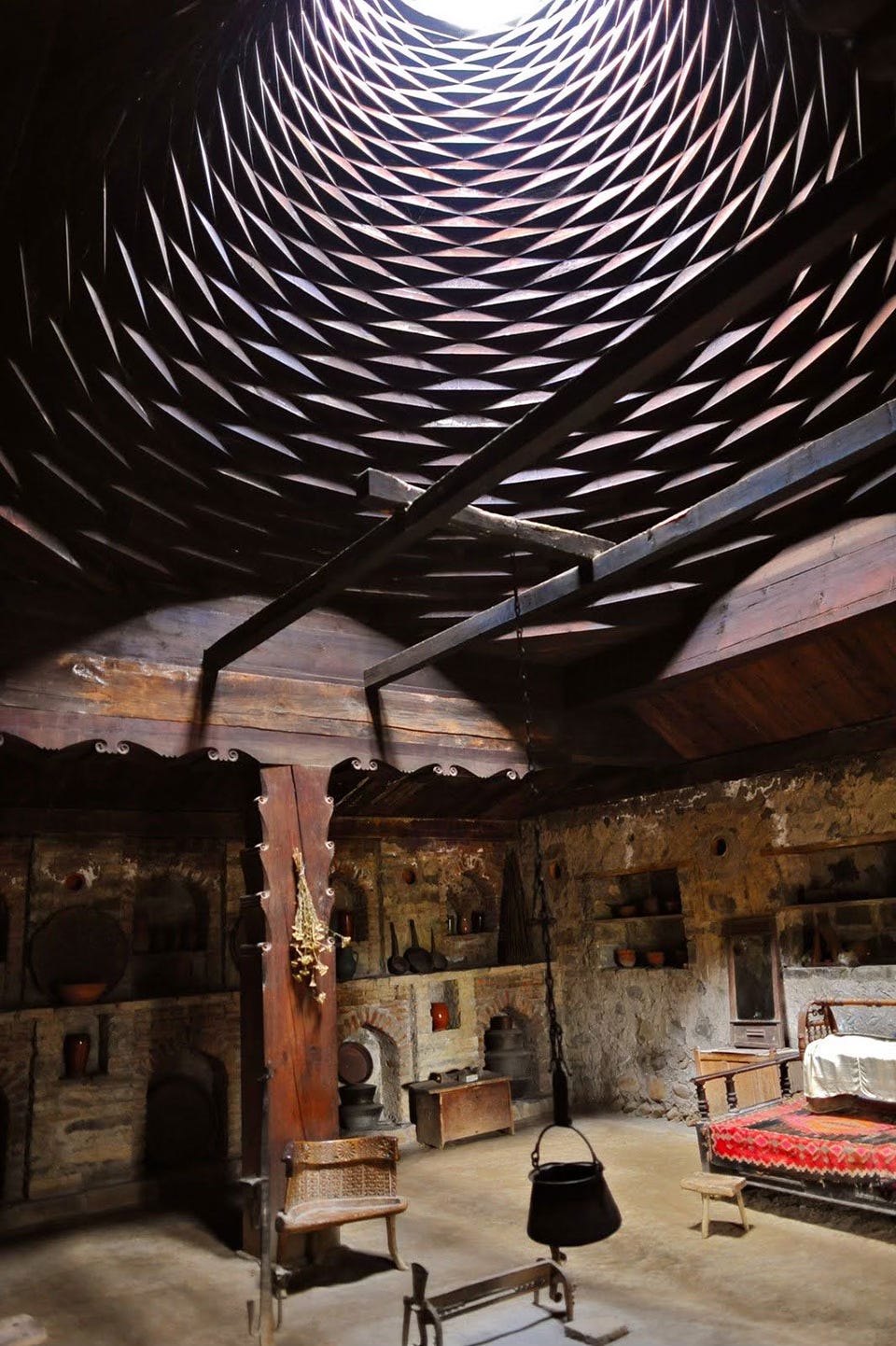
Across the Caucasus and Asia Minor, a shared architectural history exists in the form of the darbazi dwelling, going back at least 600 to 800 years, if not millenia. Although it disappeared from Tiflis1 in the 19th century due to its inability to meet the needs of city living, it used to be widespread in both cities and villages in Kartli, Kakheti, and Samtskhe-Javakheti2, where it was known as darbazuli sakhli [1].
From the Persian darvāze, or “gate/gateway”, the term typically refers to a large entrance, such as a city gate but in some contexts it can more broadly mean a grand door or entrance. The structure itself reflects a chamber with a stepped, pyramidal wooden dome (known as gvirgvini or “crown”) supported by carved pillars. It often includes a central “mother-pillar” (dedabodzi) and an open oculus at the top for light and smoke ventilation from the hearth below [2]. The adoption reflects centuries of intense Iranian-Georgian cultural and political contact, especially during the Sasanian and Safavid periods, when parts of Georgia fell under Persian rule or influence. However, the Georgian dedabodzi also preserves, in wood, a very old architectural idea that appears much earlier in stone in Anatolia (ex. Göbekli Tepe) [3].
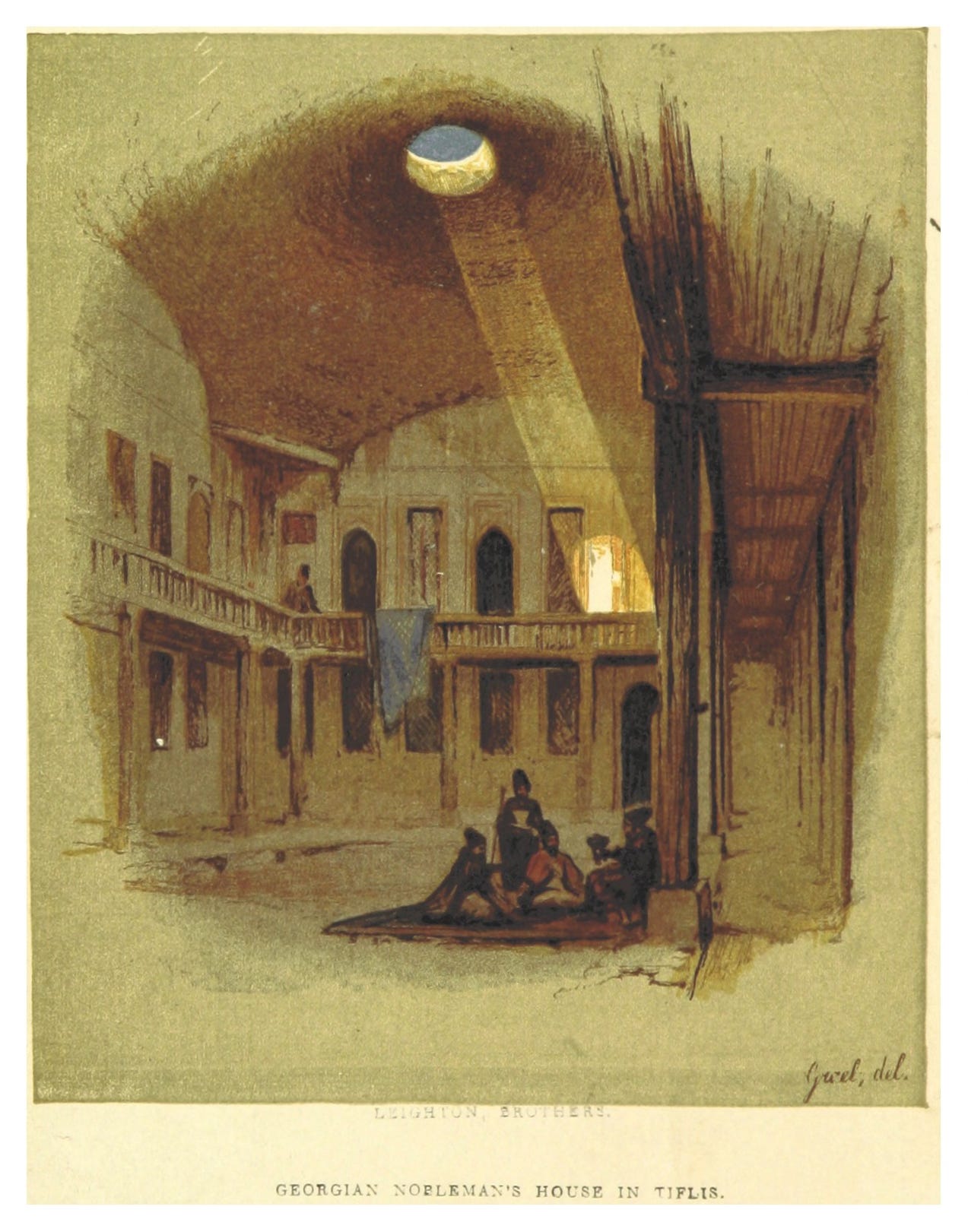
The Roman writer Vitruvius, in Book II of his De architectura, in the 1st century BCE, identified proto-darbazi structures in the regional wooden house traditions of the Colchis [4]. These were described3 as having an interior-centered space, heavy timber construction and climatic adaption.
The darbazi form might have influenced the early Christian architecture of Georgia, as the square interior space with a central roof structure draws the eye upward. Early Georgian Christian churches, especially the small, early basilicas and domed churches, reuse the same spatial logic.
Ethnographic accounts from Georgia note that when families relocated, they did not abandon the symbolic core of the house. The dedabodzi, the hearth, and sometimes the crown or main beams were ritually carried to the new settlement, preserving continuity with ancestors rather than replicating a structure exactly [3]. In that sense, the darbazi was a transferable architectural idea, rather than just a building. Its disappearance from modern cities doesn’t mean its interior logic, such as its emphasis on structure and meaning, can’t be carried forward into the future.
Additional information
1 - Vernacular Arch Geo (IG)
Sources
1 - Nineteenth-Century Architecture of Tbilisi as a Reflection of the City’s Cultural and Social History
2 - დარბაზული სახლი
3 - დედაბოძიანი სახლის სათავეებთან (Origins of Domed Pillar Houses)
4 - Marcus Vitruvius Pollio: de Architectura, Book II
the previous name for Tbilisi
in Kartli–Kakheti it was a single-hall type (large, with an entrance corridor) while in Samtskhe–Javakheti and Trialeti it was a complex or “modarbazuli” type where all living and economic spaces (darbazi, oda/room, stable, barn, hayloft, granary, wine cellar, etc.) were arranged horizontally under one roof
“The woods of the Colchi, in Pontus, furnish such abundance of timber, that they build in the following manner. Two trees are laid level on the earth, right and left, at such distance from each other as will suit the length of the trees which are to cross and connect them. On the extreme ends of these two trees are laid two other trees transversely: the space which the house will inclose is thus marked out. The four sides being thus set out, towers are raised, whose walls consist of trees laid horizontally but kept perpendicularly over each other, the alternate layers yoking the angles. The level interstices which the thickness of the trees alternately leave, is filled in with chips and mud. On a similar principle they form their roofs, except that gradually reducing the length of the trees which traverse from angle to angle, they assume a pyramidal form. They are covered with boughs and smeared over with clay; and thus after a rude fashion of vaulting, their quadrilateral roofs are formed.”