


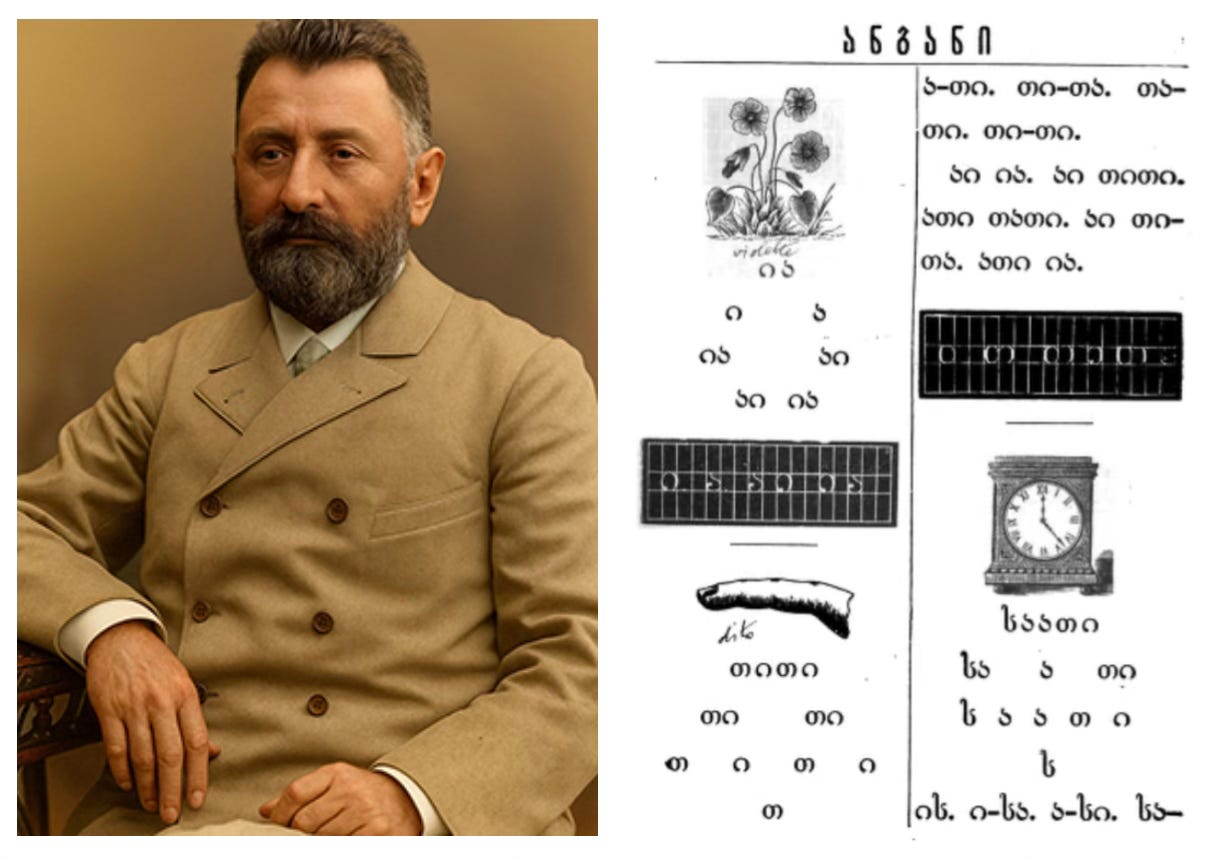
After the annexation of Georgia in the early 1800s, Russian became the language of administration, education, and the elite, while Georgian remained the everyday language of most people. By the mid-century, Georgian faced heavy Russification pressure and was pushed out of many schools. Publishing in Georgian was also tightly restricted, though censors allowed certain non-political texts. Among its roughly one million native speakers, the language survived on the streets, in markets, in the home, in rural communities, and through an enduring children’s primer.
The Deda Ena, created in 1876 by Iakob Gogebashvili, is one of the first and most popular Georgian-language textbooks for children. In one form or another, it has survived into modern times as the main way that Georgians learned to read and write in their own language using meaningful words and phrases. Before it, he had published a more straightforward book called The Georgian Alphabet and First Reader for Students in 1865, as well as The Gate of Nature in 1868, an encyclopedia of natural sciences for upper-level primary school students.
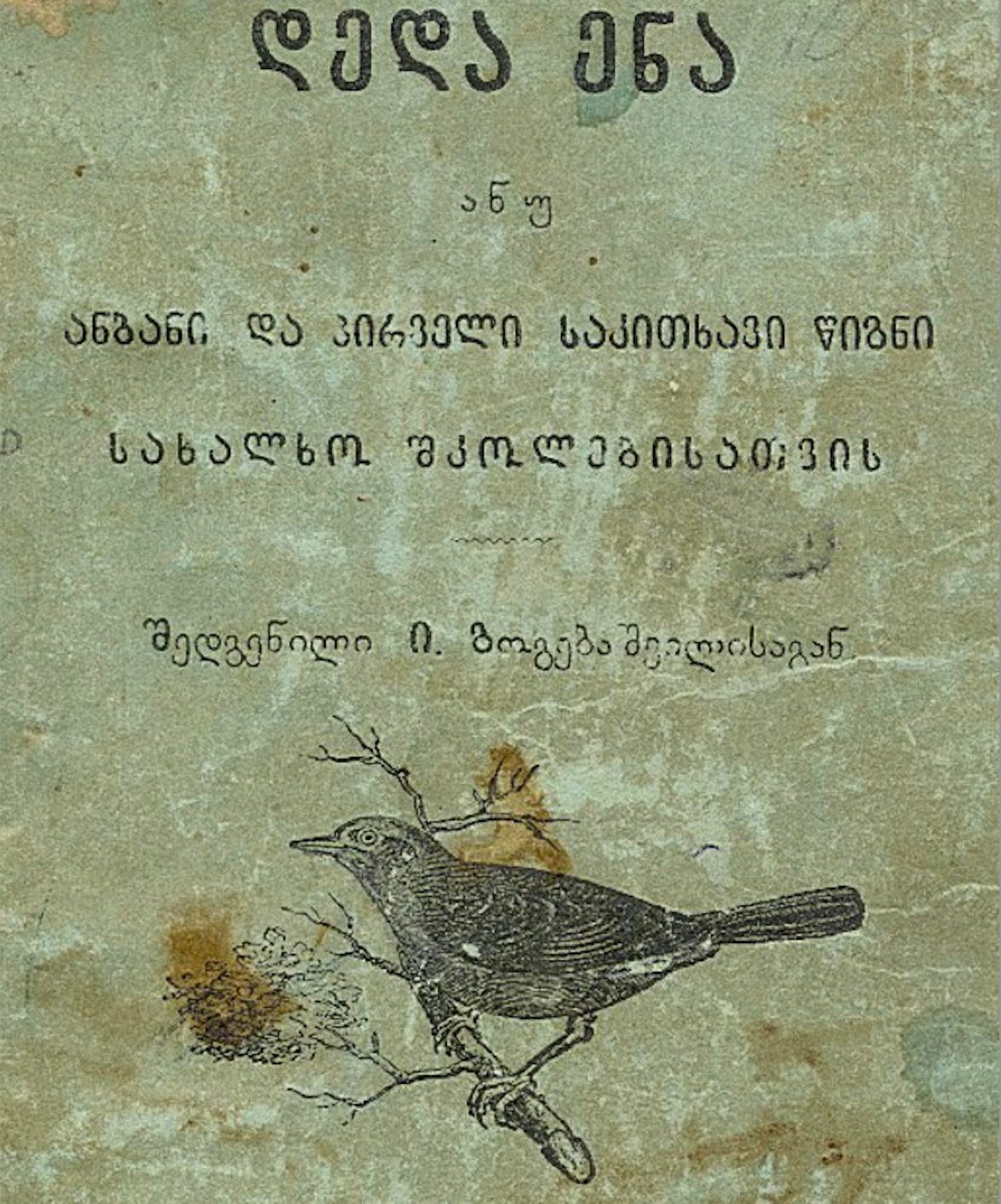
Iakob sequestered himself for six months in a remote village, on the banks of the Liakhvi, and carefully compiled the Deda Ena. In his own words, he “focused solely on one task: to gather as many examples of folk speech as possible, those that carried educational and pedagogical value…”. His dedication was driven by an idea that he couldn’t shake: that kartuli ena, the Georgian language, was so depreciated that it was akin to a “wretched foundling, deprived of all care and protection” [1]. And he worked relentlessly to change it.
მხოლოდ დედა-ენა არის ენა სულისა და გულისა, - ყველა უცხო ენანი კი არიან ენანი მეხსიერებისანი…
Only the mother tongue is the language of the soul and the heart, - all foreign languages are the languages of memory…
— Iakob Gogebashvili
Several years before his death, in 1912, the Deda Ena was split into two books: one for learning to read & write and the other focusing on teaching a variety of subjects in the humanities and sciences. Since 1925, the original version hadn’t been published, and any later primers only adapted the original without crediting Gogebashvili.
Recent Revival
A group known as the Iakob Gogebashvili Society pushed for years to restore the original Deda Ena to schools and, while it was approved in 2009, it was ultimately deemed outdated. In 2019, Georgia’s Parliament reinstated the 1912 version of the book into the official educational curriculum, with the goal of creating special conditions for its “vitality, documentation, research, identification, and popularization” as an item of intangible cultural heritage [2].
Today, Iakob’s name can be found across several educational institutions in the country’s capital, on a monument1, in a street name (in the Vera district), an educational medal and a public holiday. But his influence goes beyond his own publications.
Gogebashvili’s teaching method, built on repetition, progression, and intuitive associations created the kind of mental “readiness” later formalized by the father of Georgian psychology, Dimitri Uznadze, as the “theory of attitude” [4]. In short, the theory is based on the idea that people develop a subconscious mental set that shapes how they perceive and respond to the world. In that sense, the primer laid the groundwork for one of Georgia’s most influential and global contributions to modern psychology. Deda Ena’s influence didn’t stop at language, it helped lay the mindset that later scholars, like Uznadze, would build on. Over 150 years later, its pages still shape how Georgians think and learn.
Additional Information
1 - Video lessons for children on reading & writing in Georgian (based on Deda Ena)
Sources
1 - „დედა ენამ“ რა ჰქმნა?!“ - ლეგენდა „აი ია“-ზე - ეტალონი
2 - “დედა ენის” დაბრუნება - სახელმძღვანელო თუ კლასგარეშე საკითხავი?
3 - Gogebashvili Iakob - Georgian Encyclopedia
4 - Father of Georgian psychology Dimitri Uznadze and his “Theory of Attitude and Set”
titled Deda Ena, the Bell of Knowledge, reflecting the 19th-century mission and ideals of the Georgian “Society for the Spreading of Literacy”